Katrina O'Brien:
Realm of Trees
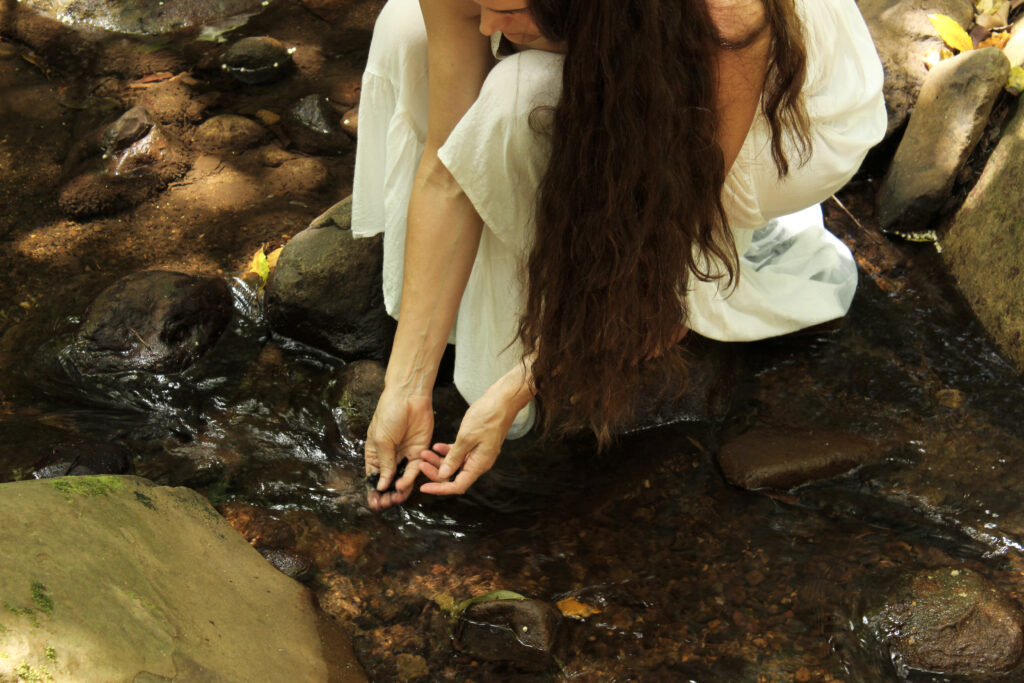
Katrina O’Brien is the timekeeper of her own mystical language — and if you’ve witnessed her conducting her words like a choir, you’ll know the only thing missing is a baton.
You describe the forest as offering something new on each visit. How did you keep track of what you encountered — notes, sketches or recordings?
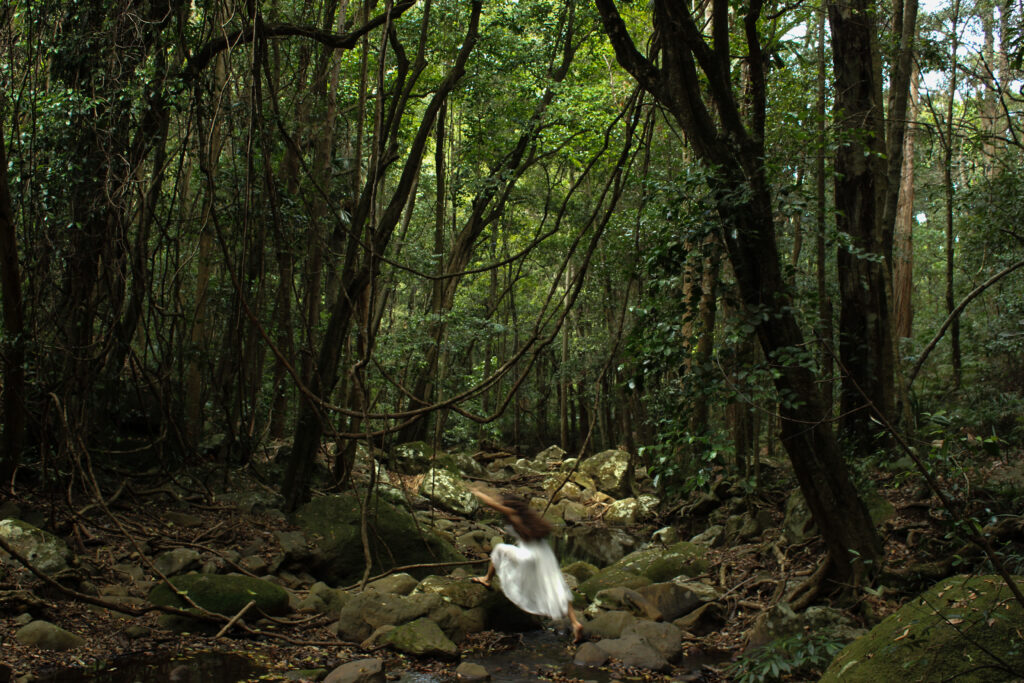
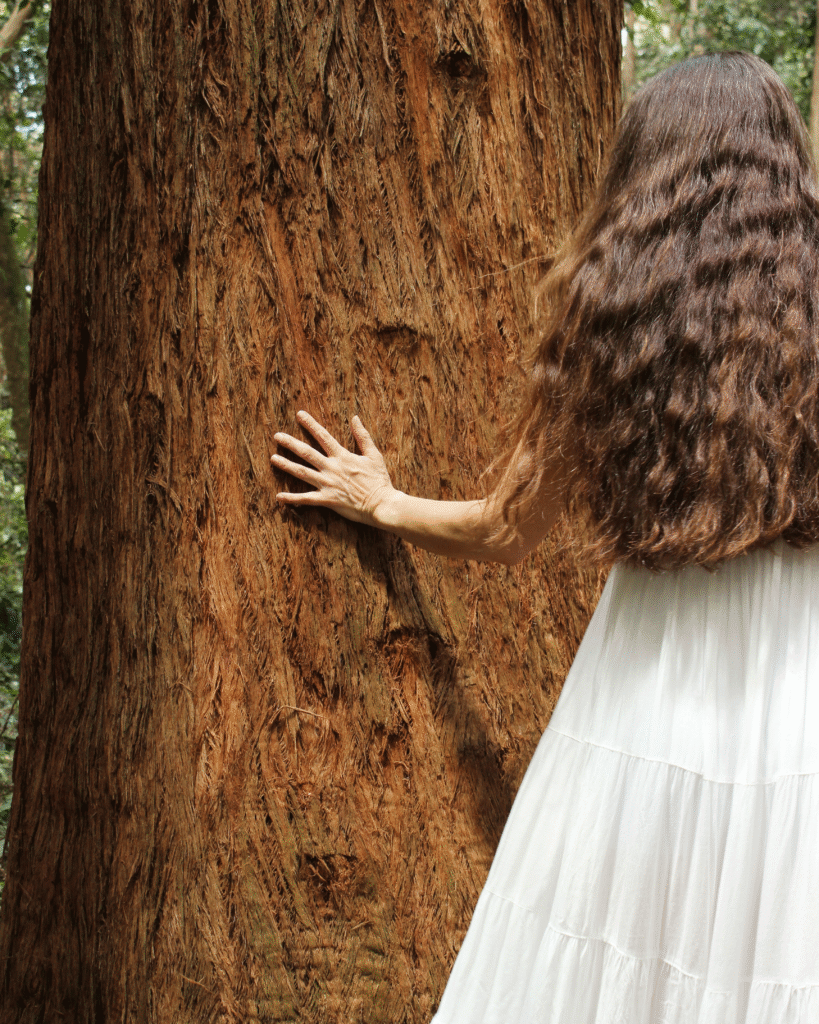
A lot of my remembering and recording of places and experiences is mapped out in the senses then tucked away in my mind for the studio. I also made a lot of notes and recordings – sometimes in the form of scribbling down a few words to remember, or sometimes in the form of weird poetic narrative. I wasn’t interested in capturing an objective or literal sense of the forest, but the forms that came out in the initial drawings mirror the forms of what I’ve seen or touched. Sometimes I would focus only on the rocks and their place within the environment, other times it would be the light, or the sounds of birds. I think when you’ve been in a space many times, it’s easy to become blasé and rely on what you know will be there. Sometimes I would go after the rain and there would be different smells and deeper tones within the bark, or the creek would rage. The temperature changes too – the deeper you go it becomes cooler, and obviously the higher up the track, the warmer it is. The scent of perfume lingering in the air let me know that there would be people along the way and I would alter my course. Sometimes there would be fallen trees which was a reminder that even in a place that is seemingly serene, it harbours a real possibility of danger.
You describe one painting as the source of the whole series. What did that work establish that the others built on?
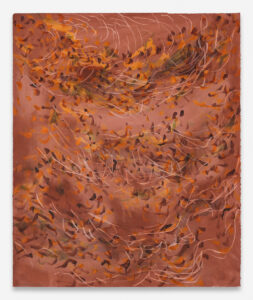
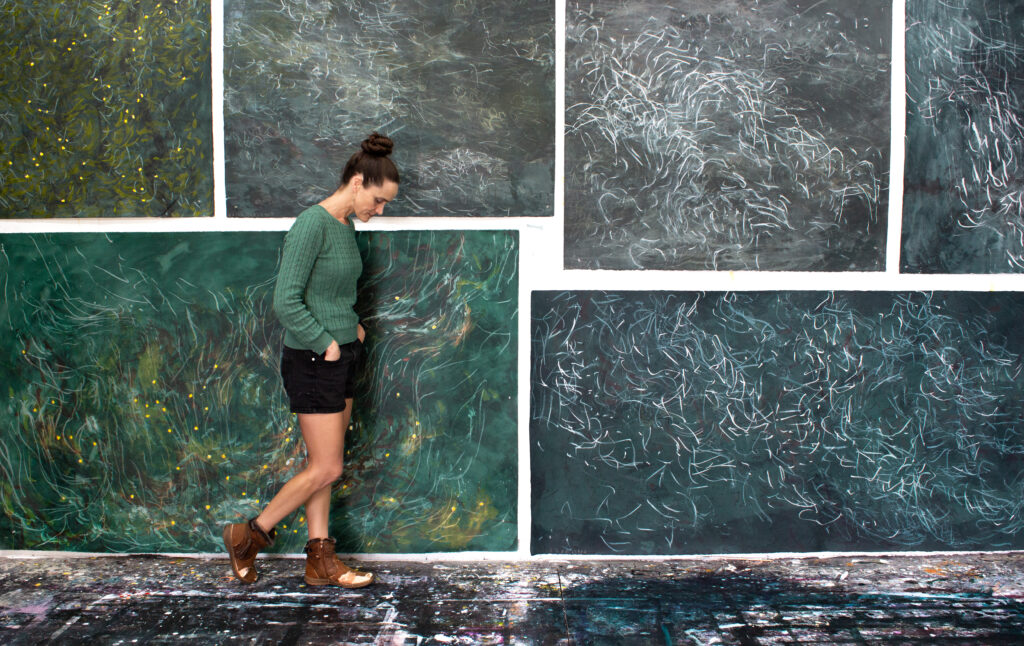
Symphony Of The Realm Of Trees has elements that mark the birth of the other works. That painting is a bit of an unusual green for a forest, but as it evolved, it began to speak of multiple sensory experiences I’ve had within the forest. I like when things are a little off-beat or not exactly as the should be. It brings light, hidden language, tangled vines, references to water and pathways. I never try to force a work because they fight back when I do that. This work happened and then I knew the ecosystem would follow, delving deep into what that environment felt like. I think it pulled together the different elements of the symphony in one painting, like a crescendo. I thought I could cap the series at five works, but seven works in, I realised it was going to be much bigger. It was at this point Mahler’s Adagietto came gently but commandingly through my speaker and I fell down a rabbit hole…
“Sometimes there would be fallen trees which was a reminder that even in a place that is seemingly serene, it harbours a real possibility of danger.”
You came to Gustav Mahler through the Adagietto and discovered an unexpected connection between his music and your work. Can you tell me about it?
Every now and then I will hear something that stops me in my tracks. All I know in that moment is that there is something there for me, something for me to find, something relevant, something uncanny. I don’t know what it is or why it happens, but I always follow it. When Mahler’s Adagietto came on, I felt this eerie familiarity like we were speaking the same language or something. I went down the rabbit hole and discovered that Mahler viewed his works as whole worlds, containing and expressing everything about the human experience from the dark to the light, and everything in between. The way he described his work was how I viewed not just this new series but my entire life’s work, I just never really found the right words. In that moment it gave permission for me to really let Realm of Trees expand and be expressed to a much fuller extent.
I don’t know if it’s a subconscious deciphering of someone else’s language, or just something in the sounds themselves, but it’s uncanny where it leads. I follow that thread and it has yet to fail me. This particular landscape of Mahler’s fell right into my ears, down, deep down into a place that fit. I’m not finished with Adagietto – there is much more to be explored specifically within that movement.
Your marks often travel from one work into the next. How did you manage that continuity across a series of this size?
More works means more thought about how they all fit in with each other especially when the studio wall can only hold so many at once. It’s a bit like a game of chess – I have to think a few steps ahead, all while keeping a map in my head of what isn’t visible on the walls, and try to shift and balance everything as a whole, but at the same time allowing myself to get completely lost in the works in front of me. I’m not just working to resolve a single painting, I’m working to make an entire entity flow and I suppose I’ve always imagined writing a symphony to be that way, having to keep in mind all the other parts and how they fit in. Sometimes it’s just the strings, sometimes strings and piano, sometimes the full blown depth of the orchestra all at once. It’s about taking pieces of each work and pulling it into another – but not by deliberate force, often by natural coincidence and intuition. Realm of Trees demanded much from me, but I deliberately slowed the whole process down so I could absorb it all a bit more. That, and there was much more physical rotation of the works on and off the wall and floor.
I have a habit of writing on my studio walls as I work so even when a painting is taken down and replaced by another, I can still recall the elements within and what it speaks to. The wall is it’s own intricate web of the work, and a single written word can prompt me to recall the work that was placed at the bottom of the pile weeks earlier.
What does ink on paper allow in this series that painting on canvas would not?
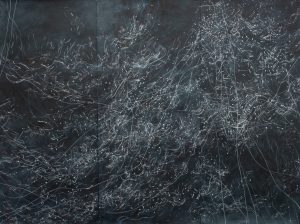
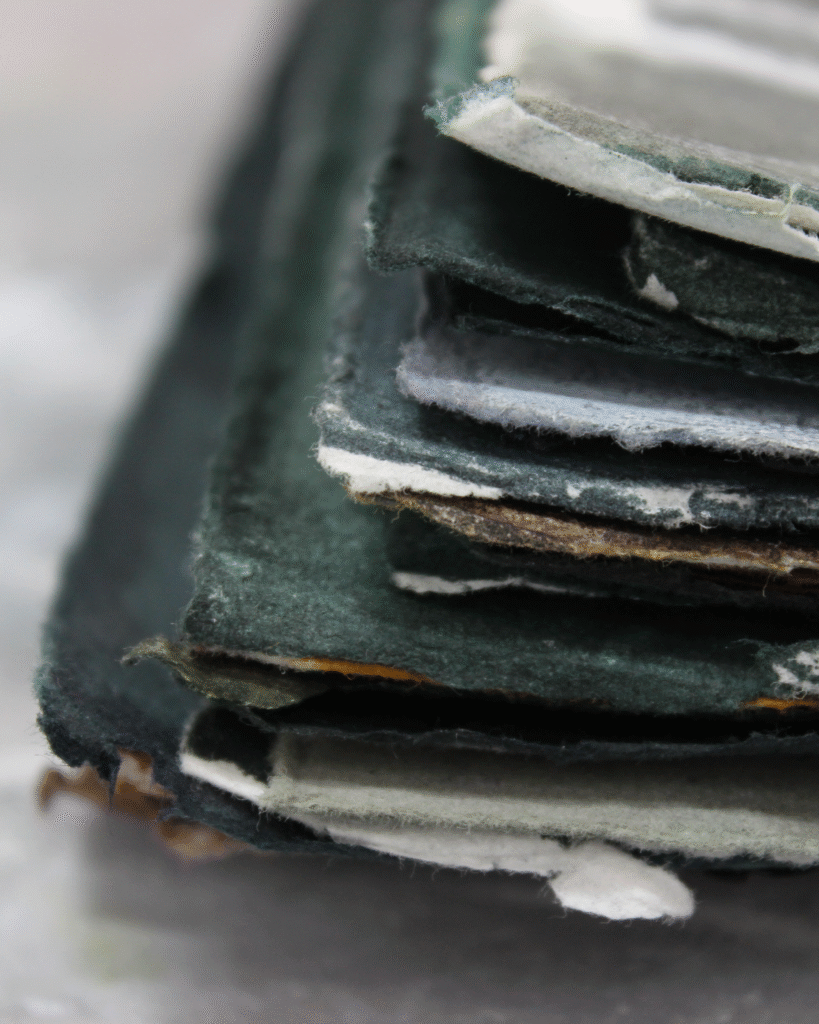
Paper tells the history of marks, shows thought processes and leaves an echo of what was laid down first. When you make a mark on paper, it is much harder to erase than on canvas. Even if you can erase a small pencil mark cleanly, the surface of the paper will be slightly scratched and weaker than it was before the erasure. The history of the marks, the washing back of layers and digging into the surface is much like how water erodes rock or soil which creates a history that you can trace, even if it has become faint. On my walks I found fossilised shells in rocks in the creek bed – such history made it hard not to think back in time and imagine what was. All the life that came before me; histories buried under the soil, layers of earth laid through cycles of life and death. And so I did imagine what it would sound like if they were all whispering. What stories would they tell.
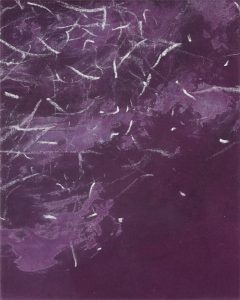
I can’t always predict how the paper will respond. This series tested me, sometimes the paper misbehaved and I had to find different solutions to problems. There are a couple of works where I have really played with the transparencies of certain layers and colours which may be challenging in some light. Two works actually mirror the process of the canopy lighting up. In my studio they are a greenish tone, but when taken out into different light they take on a more golden brown tone, but when placed in dappled light the green pastel sitting on top lights up a little like the experience of light through the leaves in the canopy.
Even the act of framing is a part of it, encasing relics found, preserving the histories within. Canvas just doesn’t hold the same gentle intrigue.
Photography courtesy of the artist.