Video courtesy of Curatorial+Co.


All Insights
William Versace:
William Versace:
Future Unearthed | William Versace | Curatorial+Co. Gallery
With equal measure of fascination and concern, William Versace began ‘Future Unearthed’ with his own creations of plastiglomerates. Known colloquially as ‘plastic gems’, these naturally fused anthropogenic rocks are made from a mixture of natural debris and plastic, and are found embedded in the earth’s surface. As a physical marker of human impact on the environment, these amalgamations point to what relics our descendants may unearth in the future.
Versace’s fascination with the environment holds deep roots — from the age of two, reciting botanical names to his father in the garden, through to adulthood, crouching barefoot amongst rockpools watching sea snails crawl through sand. His mind resides in the outdoors. His art is the way he succumbs to this awe, each work a love letter to place — a time of respect and reverence. Equally as important, he uses his work to highlight the ever-present dialogue between the natural and manmade worlds.
On first encounter, the works do not scream of the organic; rather, they appear seductive, with a luxe stimulus and futuristic appeal. It is only when the viewer looks closer, reads a title, or sits with the works a little longer that the engagement with nature becomes apparent. The more obvious reference to organic form is the Geode series, which stands tall in its crystalline form. These towering columns reveal modes of removal and impression, with one side exposed, emulating an open-cut gemstone. An uncovered gem sparkles at the opening.
The Geodes meet you with a hollowed ‘ghost form’ of household consumer waste — gaming controllers, vapes, phones, and COVID tests. Immortalised in amber resin, like a mosquito trapped in sap, these are relics of our own time, a social marker of globalisation and digitisation.
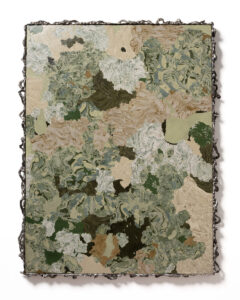
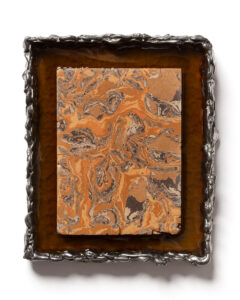
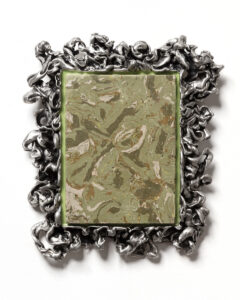
Other works, like his scagliola tablets, are more subtle, where the use of natural pigments made from sea urchin spines, seaweed, or raw ochre permeate against plastic and artificial pigments wrapped in seaweed-cast pewter forms. In the making of his tablets, Versace sifts plaster with pigment through his fingers, mixing it with binders in a process reminiscent of pasta-making from his Calabrian heritage. The composition of these works is layered in a way that makes the viewer feel as though they have happened upon a slice of the earth — strata lines holding memories of time through heat and compression.
Perhaps the most remarkable of these scagliola tablets is his ‘Bleached’ series, which illustrates the effect of rising temperatures on coral fields. Each of the five works morphs across the wall, melting and warping as a chronological signifier of temperature, to be read from left to right. The first work, 1997 +4°C Bleached, depicts a major climate catastrophe, one of the first to occur within Versace’s lifetime. The work starts off vibrantly coloured as a representation of the sea organisms’ electrifying pigments, only to be interrupted by markers of ‘white’ that begin to make their way across the series, eventually dominating the composition in the final work, 2000 and When? — a question the artist poses to his audience.
The most intimate works of the series involve human–place collaboration, surrendering human control and employing sea snails, rain, and salt to complete the work. Well acquainted with this way of working, Versace has recreated a series of collaborations first developed two years ago, when preparing for his previous exhibition titled Directions Back Home. Tragically, his art studio suffered a fire just two months before the show was set to exhibit. Versace lost his markers of time imprinted by nature, much like the violence and destruction of nature herself, but again he relinquished control. Only two scagliola works survived the fire, now finished for Future Unearthed.